The war that most Americans are clueless was fought between Armenia and Azerbaijan in the south Caucasus region……while we Americans were fixated on the election people were dying in an old hatred….
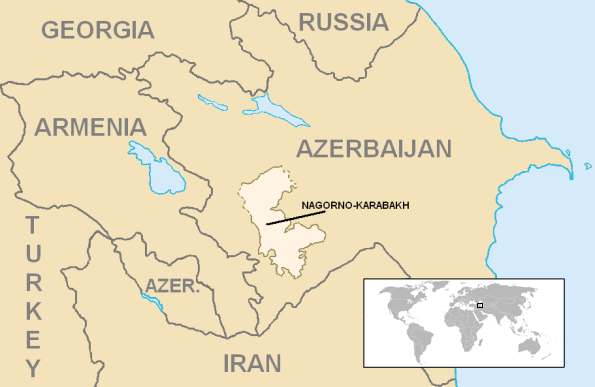
First where is this problem region?
To explain the feelings and desires of the region…..
I will let others trying to fill in the blanks for my readers…..
Troops from Azerbaijan have begun occupying some of the disputed territory….
Azerbaijan said Friday its troops had entered a district bordering Nagorno Karabakh handed back by Armenian separatists after almost 30 years as part of a Russian-brokered peace deal to end weeks of brutal fighting in the region.
Troops moved into the district of Aghdam, one of three due to be handed back, the Azerbaijan defense ministry said, a day after columns of Armenian soldiers and tanks rolled out of the territory.
Armenia will also hand over the Kalbajar district wedged between Nagorno Karabakh and Armenia on November 25 and the Lachin district by December 1.
On Thursday Armenian residents of Aghdam hurriedly picked pomegranates and persimmons from trees surrounding their homes and packed vans with furniture, before fleeing ahead of the official deadline to cede the mountainous province.
Hopefully the ceasefire holds and no more people have to die…..
But most Americans will want to know who won the war. It is an American obsession to put everything into wins or losses…..
My thought is that the outside instigators actually won not those fighting and dying…..Turkey/Russia comes to mind…..
Turkey’s intervention in September with military advisers, precision drones and Syrian mercenaries allowed Azerbaijan to wrest back all its territories occupied by Armenia for almost three decades in six bloody weeks. The country’s strongman President Ilham Aliyev has been given a big boost. Turkish hard power has shifted the balance in the south Caucasus, much as it’s done in Syria and Libya. Yet Moscow, which sat on its hands through much of the conflict, is seen by many as the real winner. Is it?
Defeat has been cruel and humiliating for Armenia. Its leaders are being assailed by a furious public as traitors. Its lost at least 1,500 soldiers, with an unstated number missing, a sizable portion of its military kit and all the land it hoped to barter for a future deal that would have given Armenian-majority Nagorno-Karabakh the right to self-determination — read: union with Armenia. A nine-point cease-fire deal brokered by the Kremlin that took effect on Tuesday effectively salvaged Armenian control over around 70% of Nagorno-Karabakh proper. Around 2,000 Russian peace keepers will be deployed in and around the enclave, spelling a return of Russian forces to Azerbaijan as well. Russia’s stranglehold over Armenia is near complete, its leverage over Azerbaijan arguably greater, to the extent that it can re-ignite hostilities.
Azerbaijani and Armenian authorities called on their local populations to prepare for war after major clashes along the front line in the Nagorno-Karabakh conflict zone left dozens of military personnel killed on both sides in late September. The fighting, which constitutes the severest military escalation since the 1994 ceasefire, could worsen in coming weeks.
Journalists and geo-strategists call it a “frozen conflict” – one of several such deadlocked disputes under tenuous ceasefire in the post-Soviet states. Only now, the long-standing battle between Armenia and Azerbaijan over Nagorno-Karabakh (NK) is anything but. For the third time since the Russian-brokered 22-year armed-truce – ending a bloody 1988-94 war that claimed some 30,000 lives – broke down in 2016, the antagonists are at it again. Yet this outbreak feels different, far bigger, with an ambitious Azerbaijan seemingly intent on cracking the whole stalemate wide open. Indeed, Baku’s bellicose rhetoric has drifted towards that ever-disturbing language of “final settlements,” “Karabakh is ours,” and of a “life-and-death war” – befitting the “blitzkrieg” intensity of the Azeri strike.
Those of us in the nerdy-niche tribe of NK-watchers would argue this latest bloodshed shouldn’t have surprised anyone. Still, almost everyone was. Thus far, through five full days of intense fighting, scores of soldiers and civilians have been killed and neither side wants to back down. Worse yet, one generic – and perceptibly inexpert – mainstream press report after another has emphasized that the recent violence could “draw in” outside powers like Russia and Turkey. Some have postulated a “worst case scenario” of “all-out war” between the two.
This is a new conflict with Turkey and Israel feeding weapons to one side and the Russians the other…..this could well turn really ugly for the region with the most war like countries feeding the flames of war.
There is so much developing in the region and we are not paying attention….why?
Our State Department is just a Trumpian tool for his version of the game of Risk.
The situation needs to be de-escalated and soon….
After a bitter three-decades-long standoff marked by sporadic violence and deadlocked negotiations, Azerbaijan and Armenia have returned to war over the breakaway territory of Nagorno-Karabakh. Clashes on the front lines followed by an Azerbaijani dawn offensive on September 27 have spilled into days of fighting that have left dozens of soldiers and civilians dead on both sides. Despite international calls for restraint, the mood among both Armenians and Azerbaijanis is bellicose. Turkish President Recep Tayyip Erdoğan has made his own hawkish statements in support of Baku. Absent urgent international action, fighting looks set to escalate further, at terrible cost.
Russia, potentially with European support, probably stands the best chance of brokering a ceasefire. Moscow is formally an ally of Armenia but has ties to both sides. Together with France and the U.S., Russia chairs the Organization for Security and Co-operation in Europe (OSCE) Minsk Group that has spearheaded peace efforts in Nagorno-Karabakh for decades. Moscow helped end the last major bout of violence over Nagorno-Karabakh in April 2016. Russian President Vladimir Putin has offered to mediate again, though striking a similar deal will be harder this time around, given that both countries, but especially Baku, have lost all faith in OSCE Minsk Group-led talks, which have largely petered out. While fighting continues, the Minsk Group co-chairs and other European leaders should press both sides to respect international humanitarian law and avoid civilian suffering.
How America Helped Create the Conflict in the South Caucasus
Hostilities have resumed between Armenia and Azerbaijan, and the United States is more to blame than you think.
Armenian people demonstrate in front of the European Council in Brussels, Belgium on 01 October 2020. (Photo by Jonathan Raa/NurPhoto via Getty Images)
On September 27, almost certainly as a result of an offensive by the Azerbaijani army, hostilities resumed between two old foes in South Caucasus, Armenia and Azerbaijan. Both sides are at loggerheads over a mountainous region of Nagorno-Karabakh—internationally recognized as part of Azerbaijan but under de facto Armenian control since the early 1990s, as are a number of adjacent Azerbaijani territories. In the dying days of the Soviet Union, both sides engaged in a bloody war. The conflict was suspended after a precarious, Moscow-mediated ceasefire in 1994, but it’s festered ever since. It was only a matter of time as to when it would erupt again.
The conflict has local drivers, and the primary responsibility for its endurance, without any doubt, lies with local political elites. However, the United States, in the heyday of its post-Cold War unipolar moment, when it felt empowered to engage just about every conflict around the world, made a number of choices that rendered the resolution of the Nagorno-Karabakh conflict more difficult.
When the South Caucasus nations emerged as independent states following the demise of the Soviet Union in 1991, Washington’s policy priorities included their swift integration into the U.S.-led liberal world order, bringing their energy riches to global markets, promoting Turkey as a regional model of a secular and pro-Western state, and excluding post-Soviet Russia, and especially Iran, from the regional integration projects. These choices ignored the historical and cultural realities of the region and failed to take into account their possible impact on the Nagorno-Karabakh conflict.
Exhibit A of such ignorance was the decision to marginalize Iran, despite its longstanding ties with both Armenians and Azerbaijanis. This reflected a feature of U.S. foreign policy: single-minded fixation on excluding and isolating Iran in all possible scenarios. While there is a case for containing Iran in the Levant, where it threatens Israel, South Caucasus represents a completely different strategic landscape.
While the US spends most its resources and time doing the bidding of Israel with Iran…..it should be watching what China is doing in the South Caucasus……
In the age of attention deficit disorder politics, this week’s flare-up of hostilities between Armenia and Azerbaijan has ensured that great powers have turned their attention to the South Caucasus. Once hostilities subside, however, this attention will inevitably turn to newer, shinier objects. Not all great power leaders will do so, however. As the emerging great power rivalry keeps the U.S. preoccupied with competing with China in Southeast Asia, the Middle Kingdom has been making inroads into the South Caucasus, which can impact U.S. energy security and other important interests. I expect this process to continue.
Over the past few years, China’s economic presence has grown in all three South Caucasus states (Armenia, Azerbaijan and Georgia), paving the way for an increase in Beijing’s geopolitical influence in the region. U.S. policymakers should watch Beijing’s moves in the South Caucasus to ensure they do not undermine the fragile political, security and economic stability in this strategically sensitive region, which is also contested by Russia, Turkey and Iran.
Armenia’s foreign ministry said it “stands ready” to work with the US, France, and Russia “to re-establish a ceasefire regime.” The US, France, and Russia co-chair the Minsk Group, which was set up in 1992 by the Organization for Security and Cooperation in Europe to promote negotiations and peace talks over Nagorno-Karabakh.
Turkey has been accused of intervening in the conflict on behalf of Azerbaijan. On Friday, Armenia’s Prime Minister Nikol Pashinyan said he has evidence of Turkish support. “We have proof,” Pashinyan said. “They are using drones and Turkish F-16 to bomb civilian areas in Nagorno Karabakh.”
I have been watching the spiraling conditions around the Caucacus….especially between Armenia and Azerbaijan……I know most Americans have no idea what I am talking about or even where…..
This conflict has been simmering since the break-up of the USSR….as I have stated I have been watching the region for trouble and I have nbeen writing about it as well…..
As you see they have been sniping at each other for years….and that “minor” conflict is getting a bit more warm….
Fighting between Armenia and Azerbaijan broke out Sunday around the separatist region of Nagorno-Karabakh and the Armenian Defense Ministry said two Azerbaijani helicopters were shot down.
Ministry spokeswoman Shushan Stepanyan also said Armenian forces hit three Azerbaijani tanks. There was no immediate word on casualties.
Nagorno-Karabakh is an ethnic Armenian enclave within Azerbaijan that has been out of Azerbaijan’s control since the end of a war in 1994. Both sides have heavy military presence along a demilitarized zone separating the region from the rest of Azerbaijan.
Azerbaijan’s defense ministry denied the claim that its helicopters and tanks had been hit. But President Ilham Aliyev said in a televised address to the nation that “there are losses among the Azerbaijani forces and the civilian population as a result of the Armenian bombardment.”
I spend a lot of time looking at “open source” intel trying to tell what will transpire……India-Pakistan have walked back from the brink of war…..Greece and Turkey are trying to solve their problems as well….but will these two ever “bury the hatchet” that is not in one another’s head?
There is the Bishtek Protocol of 1992……28 years have passed since the time when Armenia, Nagorno-Karabakh Republic and Azerbaijan have signed the Bishkek Protocol on Ceasefire and have agreed to solve all existing problems only by the help of diplomacy and according to the generally accepted principles of international law. Since 1992, after the collapse of the Soviet Empire, the Organization for Security and Cooperation in Europe has take the initiative for resolution of the existing conflict and is acting through the OSCE Minsk Group. Each year the OSCE Minsk Group, which consists of the Russian Federation, USA and France, is the mediation group and is responsible for peacemaking process, organizes a lot formal and informal meetings of the heads of three conflicting parties, but so far they have not got any positive results. Anyway, conflicting parties highly appreciate all efforts of the international community and have stated for many times that are ready to negotiate and find joint solution to the conflict on the basis of the internationally accepted and recognized norms of the international law.
Apparently diplomacy is not working…..and with the current admin in DC I do not see a diplomatic solution. So the world holds its breath that calmer heads will prevail.
Armenia and Azerbaijan have declared martial law and are moving dangerously toward war this weekend after heavy fighting in the disputed enclave of Nagorno-Karabakh. At least 16 Nagorno-Karabakh troops were killed in a morning Azeri attack.
Nagorno-Karabakh has been contested for decades. Legally it is viewed as part of Azerbaijan, while Armenia guarantees its independence. The two nations often come into conflict over the region, but haven’t fought a full-scale war for many years.
Nagorno-Karabakh reported they were hit in the morning with airstrikes and artillery attacks. Azerbaijan claimed those attacks were retaliation for Armenian shelling against their forces, which killed five civilians.
Azerbaijan has taken control of seven villages, but lost some of the territory later in the day. Russia is leading a diplomatic push to calm matters, while Turkey is threatening to join the fight.
The comments come 10 years after the brief Russo-Georgian War, during which Georgia attempted to attack South Ossetia, ended up fighting Russian troops therein, and fairly quickly lost. In the aftermath, Russia recognized the independence of both regions.
The regions are a long-term problem for Georgia, which has ambitions for joining NATO. NATO clearly would never accept anyone as a member state who has existing territorial disputes with Russia, and accuses Russia of occupying parts of their territory, since this would mean an immediate NATO-Russia war.
The State Department insists they support Georgia’s “territorial integrity” as including those regions, and to the extent that continues, it also follows that Georgia will never be able to advance toward accession into NATO.
(antiwar.com)
Demand? A country that has troops in 177 countries stationed on about 800 “bases” should not be making such demands…..maybe the US should lead by example not some infantile bullying.
The two seas I am referring to are the Black Sea in the West and the Caspian Sea in the East…..this region could very well become what is known as a linch pin event….
“Linch pin?”
I explained this in a post I wrote for another site about 4 years ago…..please read for it explains everything….this is an important situation developing……
The reason I reference this is because this region is once again heating up….
Azerbaijan and Armenia both lay claim to the territory of Nagorno-Karabakh. This disputed region is located entirely inside Azerbaijan – indeed, it is internationally recognized as Azerbaijani – but the government in Baku hasn’t exercised political authority over it in decades. That honor falls to the ethnic Armenians who populate it. In fact, Nagorno-Karabakh had been a semi-autonomous Armenian enclave ever since the Bolsheviks came to power in Russia. After the dissolution of the Soviet Union, of which Azerbaijan was a part, the ethnic Armenians living in Nagorno-Karabakh, backed by Armenia itself, fought a war with Azerbaijan to keep the territory. A truce was brokered in 1994, and though negotiations over its official resolution have continued ever since, they have been entirely unsuccessful.
Minor skirmishes there erupt every so often – the bloodiest of which occurred in 2016 – but they have never escalated to all-out war. Partly that’s because war would be detrimental to Russia. Its interests are too many in the Caucasus to allow Turkey or Iran to gain a foothold there – something they would surely do if they backed Armenia in a conflict. Still, if Nagorno-Karabakh ever is a cause for war, then Azerbaijan, whose military dwarfs Armenia’s, would have the upper hand.
(Geopolitical Futures)
Our crackerjack State Department needs to pull its head out of the president’s ass and keep an eye on this situation or it could quickly become a problem that Trump will want to fix by some sort of attack.
The region is getting more unstable as the months go by……..
The springtime political upheaval in Armenia stunned neighbouring governments – not least that of Azerbaijan. Since 23 April, when mass demonstrations impelled Armenia’s long-time leader Serzh Sargsyan to resign, the Azerbaijani authorities have struggled to understand the implications for the three-decade-long conflict between Azerbaijan and Armenia over Nagorno-Karabakh.
Prior to Armenia’s “velvet revolution”, observers in the Azerbaijani capital Baku believed Sargsyan would continue indefinitely as prime minister. At the outset of the anti-Sargsyan unrest, the demonstrations were small, and Azerbaijanis remained doubtful that the unrest would force a change in Armenian politics. They drew comparisons to “electric Yerevan” – the 2015 protests in the Armenian capital against electricity rate hikes. Even as the demonstrations grew, the Azerbaijani authorities did not imagine that Sargsyan would step down. Every previous uprising in the region had had a “geopolitical colour” – some relation to the standoff between Russia and the West – and they did not know what to make of a popular revolt centred solely on national politics.
Armenia has had an election and the new leader is hoped to bring a close to the conflict with the country’s neighbor…..but those hopes could be premature….
For the past month Armenia has coasted on a wave of popular emotion and international goodwill, ever since peaceful protests forced the resignation of veteran leader Serzh Sargsyan and brought to power opposition leader Nikol Pashinian.
Pashinian, who is 42, has appointed a new government even more youthful than himself. He has also promised to crack down on corruption and clean up the old oligarchic system. A country that many had characterized as isolated, stuck, and completely dependent on Russia has confounded stereotypes and now looks dynamic—trendy even. The revolution is still only half-finished, but for the first time in two decades, Armenia is a good news story.
I will be watching since no one else seems to care……all conflicts are important when they could possibly involve American troops…..we have enough war…..we need NO more.
We have had a Green Revolution……then there was a Red Revolution when the communists came to power…..an Orange Revolution…..a Yellow Revolution…..and the list goes on…..then there was the Velvet Revolution…..
Armenia is in that region that once wrote about as the possible linch pin to start another global upheaval….the region between the two seas…..
It took less than two weeks of protests for Armenian Prime Minister Serzh Sargsyan, the former two-term president who had previously said he would not take the premiership, to step down from the position. The leader of the protests last week called it a “velvet revolution,” a reference to the pro-democracy color revolutions of the early 2000s that swept the former Soviet Union and the Balkans. But this was no color revolution. The color revolutions pulled states out of Russia’s orbit. Armenia, however, has nowhere else to go.
In the color revolutions of the past, the West offered indirect support to the protesters through vehicles like nongovernmental organizations. Yet there is no overt evidence that the United States or any European countries directly funded or otherwise materially supported the Armenian protests. In fact, no Western government even made statements criticizing Sargsyan or his government. A few Western-funded NGOs went so far as to sign a petition in support of the protests, but this hardly suggests that a dramatic political transformation is imminent.
This region gets very little attention…..and has some of the most volatile situations in global politics…..situations that can easily transgress into a shooting war at the drop of a hat…
And then there is another look at the situation in Armenia…..
When opposition Member of Parliament Nikol Pashinyan led a knot of marchers through northern Armenia in April to protest the return to power of long-serving leader Serzh Sargsyan, no one guessed his campaign would prompt the country to take a leap into the unknown.
One of a mere handful of opposition parliamentarians, Pashinyan has never been a popular leader in this country of three million people. His criticism of the government resonated with those parts of society that oppose Sargsyan and reflected real problems. But when he set out on his march, the former journalist and publicist was a marginal figure.
IST tries to keep its finger on the pulse of the region…well as best it can without access to classified info…..
But could Russia intervene in Armenia?
The resignation of Armenia’s Prime Minister Serzh Sargsyan after more than a week of mass protests in Russia’s backyard begs the question: Why has Moscow not intervened?
The demonstrators bring to mind “color revolutions” in the post-Soviet neighborhood that the Kremlin seems to abhor, like in Georgia and Ukraine. But even genuine revolutions, which Armenia has not yet seen, are not enough in and of themselves to prompt Russia to intervene.
Armenia’s former president and just appointed prime minister, Serzh Sargsyan, resigned Monday after a 10-day campaign of nationwide protest and civil disobedience. Protests began as soon as Sargsyan announced 11 April that he would, after previously stating otherwise, seek the ruling Republican Party’s nomination to the newly created post of prime minister.
By doing so, he laid to rest any lingering doubt about the reasons for Armenia’s switch to a parliamentary system. Introduced through a contested constitutional referendum in December 2015, the new system came online just as Sargsyan’s second, and by law final, presidential term ended. Executive powers now lie with the prime minister, and the president is relegated to a largely ceremonial role.
I am always looking for that region that could push the world to another all out war….like the events in 1914…..a few years ago I wrote a post where I thought the next big “problem” would appear…..
I chose the region between the two seas…Caspian and Black…..
I read a lot of Middle East newspapers and opinions…..and recently in an Iranian source I read about a prediction that they are making about the future….
Iranian President Hassan Rouhani cautioned that extremist elements could expand their presence in the Caucasus and Central Asia after being flushed out of Iraq and Syria, calling for concerted action to stem terrorism in the region.
“After suffering a complete defeat in Iraq and Syria, terrorists are likely to try to permeate across the region. Thus, all of us should be wary of such a threat (in the region), as in the Caucasus and Central Asia,” President Rouhani said in a meeting with his Armenian counterpart Serzh Sargsyan in Tehran on Sunday.
A group that I am associated with, Center for Strategic and International Studies…..testified before the House sub-committee on the situation in the Caucuses…..
Many disassociated sources see a problem brewing….maybe more attention should be paid on these events and we could avoid another war that the world does not need.
I have been watching the events unfolding in the Caucuses….if war is to come then this will be a good place for the world to try the 2 failures of the past once again….
Women have it tough around this globe and few seem to care little about their plight…..
Women in the Russian republic of Chechnya have never been under such pressure as they are today. Yet not much has been written about their role, their place in society, and their rights in Chechnya and in other North Caucasus conflicts.
For more than two decades since 1994, the armed conflict between Russian federal forces and the insurgencies of the North Caucasus has been among Europe’s deadliest, churned by a vicious circle of unresolved religious and ethnic tensions, brutal counter-insurgency, lack of democratic procedures, social inequality, and bad governance. Instability and war resulted in a dramatic erosion of state capacity, weakened state institutions and the increased prominence of traditional and religious practices and intolerant ideologies.
I love to use the 4 most beautiful words in the English language…..”I told you so”…..
I have written en op-ed for my friends at Legationes about the region in question…..which is a paper that I researched several years ago……and it is good to see that my predictions are getting close to realization…..well not good but rather interesting……(read more)…..
There is a theory in international relations called the linchpin theory….basically, it is an occurrence, a small occurrence, that could explode into a society ending situation……a couple of good examples are WW1 and the Arab Spring…..
By Brandon Turbeville Regardless of which side you choose to listen to in the Armenian/Azeri conflict, one thing everyone can agree on is that the ceasefire is not holding. The regularly ignited di…
The events in this situation are starting to accelerate…..the question is….how much damage will this event do? Could this becoming a wider conflict? Will the major powers become involved?
Could this be the linchpin I have been looking for or is it just a minor thing that will get worked out in the end?
Ever since Russia’s invasion and conflict with Georgia (the country not the state) in 2008 I have been watching the region of the Caucasus Mountains closely. I feel that if a larger conflict is to bloom then this region has the greatest potential to become the next linch pin for war…..
I know that I link to this article a lot…..but it is one of my better analysis (plus it is a small ego boost to link to it often)…..
This region is volatile and we in the West hear very little about it….a shame because it could be our next “Big One”…..
I bring this up again because there has been yet another incident where one nation in the region is at odds with another…..this tie it is Azerbaijan and Armenia……
Two Azeri servicemen have been killed in border clashes with the Armenian army, Azerbaijan’s defense ministry said on Monday.
The Armenian defense ministry accused the Azeri side of triggering fresh confrontation along the border between Armenia and Azerbaijan and around Nagorno-Karabakh, which lies inside Azerbaijan but is controlled by majority ethnic Armenians.
Clashes between the two ex-Soviet nations and around separatist Nagorno-Karabakh have stoked fears of a wider conflict breaking out in the South Caucasus, which is crossed by oil and gas pipelines.
In an account that was disputed, Azerbaijan said an officer and a soldier were killed on Sunday when Armenian forces tried to cross the state border.
Armenia accused Azeri forces of attacking several villages near the border between the two countries, wounding one civilian at the weekend
Sporadic clashes between the two have thwarted international efforts, led by France, Russia and the United States, to end the dispute, which broke out in the dying years of the Soviet Union and killed about 30,000 people.
(Reuters)
Back in December 2015 there was another clash between the two nations…..
Armenia says a ceasefire with neighbouring Azerbaijan over the breakaway region of Nagorno-Karabakh no longer exists, describing frequent skirmishes at the front line as “war”.
Artsrun Hovhannisyan, a spokesman of Armenia’s defence ministry, said on Tuesday that Azerbaijan was using “all existing armaments: tanks, howitzers, and anti-aircraft artillery” against Armenian soldiers in the disputed region.
“What we have today is a war,” said Hovhannisyan. “We must use the word ‘war’ as there is no ceasefire anymore.”
Azerbaijan responded with counter-accusations, blaming Armenia for the recent escalation.
(Al-Jazeera)
There have been a war of words between the two since the collapse of the USSR…..and now it is becoming more harmful than in the past….will this lead to the “Big One” that could involve the rest of the world since we are setting ourselves up to “good guys versus bad guys”, a bi-polar world, yet again.
Heavy fighting has broken out between Armenian and Azerbaijani forces along the front lines of the separatist Nagorno-Karabakh region, reportedly killing at least one child in what one official called the worst clashes since 1994. Officials from each former Soviet republic blamed the other Saturday for the fighting that began overnight, the AP reports. Both Armenia and Azerbaijan said they had inflicted heavy losses on the other. David Babayan, a spokesman for Nagorno-Karabakh’s separatist president, said a boy of about 12 was killed and two other children wounded in a Grad missile barrage by Azerbaijani forces. Azerbaijan says 12 of its soldiers were killed and around 100 Armenian forces were killed or wounded.
Vladimir Putin has urged all sides to cease firing and “show restraint,” a Kremlin spokesman says. Nagorno-Karabakh, a region in Azerbaijan, has been under the control of local ethnic Armenian forces and the Armenian military since 1994. The Armenian Defense Ministry says Azerbaijan used aircraft, tanks, and artillery to try to make inroads into Nagorno-Karabkh and that “Azerbaijani authorities bear all responsibility for the unprecedentedly supercharged situation.” The Azerbaijani Defense Ministry says the fighting began when Armenian forces fired mortars and large-caliber artillery shells across the front line.
Could a recent meeting between Kerry and the Azeri president just added fuel to this fire?
The Nagorno-Karabakh situation, whereby a territory that the UN recognizes as part of Azerbaijan is under the control of an unrecognized autonomous government backed by Armenia, has sat unresolved and rarely spoken of for 22 years. The resumption of hostilities this weekend, however, comes just days after Secretary of State John Kerry spoke to Azeri President Ilham Aliyev, calling for an “ultimate resolution” to the conflict.
Kerry made it clear he wanted a diplomatic settlement, but that still doesn’t mean his comments didn’t play a role in precipitating these new hostilities, if it convinced Aliyev that the US isn’t going to allow the status quo to remain in place.
Finally a report issued by the International Crisis Group can help my reader understand this situation….more so than trying to get reliable information from the MSM…….
The Nagorno-Karabakh conflict has long been regarded as a tinderbox in the heart of the South Caucasus – with serious implications for the wider region including Russia, Turkey and Iran. Each spring, when low-level violence tends to break out, policymakers worry about incidents spiraling out of control due to miscalculation or escalation by leaders in […]
It appears that my paper about the region is looking more and more accurate….this could well be the next linch pin that plunges the world into darkness….yet again.
Armenian President Serzh Sarksyan warned a group of foreign ambassadors today that the war could have “unpredictable and irreversible consequences, right up to a full-scale war,” cautioning that both Russia and Turkey could quickly become involved.




 The comments come 10 years after the brief Russo-Georgian War, during which Georgia attempted to attack South Ossetia, ended up fighting Russian troops therein, and fairly quickly lost. In the aftermath, Russia recognized the independence of both regions.

