Reparations? No Thanks!

Here in the US with all the protests for racial equality there have been some that are calling for reparations to be paid to black ancestors of slaves…..

Of course they use the fact that the US has paid reparations to Japanese-Americans for their treatment during World War Two….

But this post is about something other than US slavery…I know hard to believe that there is something more important than the events in the US….but amazingly there is……and it is the history of Africa and the region unknown in the day as German Southwest Africa.

German South-West Africa, or present-day Namibia, was a colony of the German Empire from 1884 until 1915, when it was occupied by South African forces fighting on the side of Great Britain in World War I. The brief history of the colony was marked by a series of insurrections by the Khoekhoe and Hereros against German rule, insurrections that the authorities suppressed with extraordinary harshness. The German ambition was to populate the colony with large numbers of settlers from Germany, much as the British had done in other parts of Africa. By 1914 more than 9,000 German settlers were living in the colony, but the dry climate and lack of water was a limiting factor on further settlement and expansion. Theodor Rehbock was a noted German hydraulic engineer who was asked by a local syndicate to study the colony’s water resources and their potential use in irrigation projects. Rehbock visited German South-West Africa in 1896-97 and produced this analysis of its economics, geology, climatology, and hydrology. His work contains detailed maps, tables, and plans for water projects. It remains a valuable resource for the study of the history of Namibia.

A little more historical perspective…..

In 1884, German chancellor Otto von Bismarck convened a meeting of European powers known as the Berlin Conference. Though the conference determined the future of an entire continent, not a single black African was invited to participate. Bismarck declared South-West Africa a German colony suitable not only for trade but for European settlement. Belgium’s King Leopold, meanwhile seized the Congo, and France claimed control of West Africa.

The German flag soon became a beacon for thousands of colonists in southern Africa—and a symbol of fear for local tribes, who had lived there for millennia. Missionaries were followed by merchants, who were followed by soldiers. The settlers asserted their control by seizing watering holes, which were crucial in the parched desert. As colonists trickled inland, local wealth—in the form of minerals, cattle, and agriculture—trickled out

Indigenous people didn’t accept all this willingly. Some German merchants did trade peacefully with locals. But like Belgians in the Congo and the British in Australia, the official German policy was to seize territory that Europeans considered empty, when it most definitely was not. There were 13 tribes living in Namibia, of which two of the most powerful were the Nama and the Herero. (Kaunatjike is Herero.)

Germans were tolerated partly because they seemed willing to involve themselves as intermediaries between warring local tribes. But in practice, their treaties were dubious, and when self-interest benefitted the Germans, they stood by idly. The German colonial governor at the turn of the 20th century, Theodor Leutwein, was pleased as local leadership began to splinter. According to Dutch historian Jan-Bart Gewald, for instance, Leutwein gladly offered military support to controversial chiefs, because violence and land seizure among Africans worked to his advantage. These are all tactics familiar to students of United States history, where European colonists decimated and dispossessed indigenous populations.

(Smithsonian Magazine)

If you would like more info then this site may be of some assistance…..https://www.sahistory.org.za/place/namibia

Now that we have set the stage….Germany has offered reparations for the ills foisted upon the natives…..and Namibia has declined the offer……

Namibian President Hage Geingob on Tuesday turned down Germany’s offer of €10 million ($11.7 million) in reparations for the genocide committed by the German Empire at the start of the 20th century.

“The current offer for reparations made by the German government remains an outstanding issue and is not acceptable to the Namibian government,” Geingob said in a statement after a briefing on the status of negotiations. He added that the government’s special envoy, Zed Ngavirue, would continue to negotiate for a “revised offer.”

Geingob also took exception to Germany’s use of the term “healing the wounds” in place of the word reparations, saying the terminology would be debated further.

No apology so far

The two countries began negotiating an agreement in 2015 that would see Germany give an official apology and development aid as compensation for the killing of tens of thousands of indigenous Herero and Nama people by German occupiers in 1904-1908.

https://www.dw.com/en/namibia-germany-reparations/a-54535589

Maybe an apology would make things go better…..

Just a thought.

I Read, I Write, You Know

“lego ergo scribo”

“Making America Great Again”–Part 21

The United States has come out of the Industrialization phase and into the period of expanding their influence on the world stage….even to the point of imperialism….think…Guam, Philippines, Cuba, Puerto Rico and Hawaii……not sure what I am speaking of?

This series is an excellent look at American history written by Maj. Danny Sjursen……plus if you have not been reading this series from the beginning…..I give you a reference to the series……

See: Part 1; Part 2; Part 3; Part 4; Part 5; Part 6; Part 7; Part 8; Part 9; Part 10; Part 11; Part 12; Part 13; Part 14; Part 15; Part 16; Part 17; Part 18; Part 19; Part 20.

Part 21 of “American History for Truthdiggers.”

Empire. It is a word that most Americans loathe. After all, the United States was born through its rebellion against the great (British) empire of the day. American politicians, policymakers and the public alike have long preferred to imagine the U.S. as, rather, a beacon of freedom in the world, bringing light to those in the darkness of despotism. Europeans, not Americans, it is thought, had empires. Some version of this myth has pervaded the republic from its earliest colonial origins, and nothing could be further from the truth.

According to the old historical narrative, the U.S. has always been a democratic republic and only briefly dabbled (from 1898 to 1904) with outright imperialism. And, indeed, even in that era—in which the U.S. seized Puerto Rico, Guam, Hawaii and the Philippines—the U.S. saw itself as “liberating” the locals from Spanish despotism. This wasn’t real imperialism but rather, to use a term from the day, “benevolent assimilation.” Oh, what a gloriously American euphemism!

https://www.truthdig.com/articles/american-history-for-truthdiggers-tragic-dawn-of-overseas-imperialism/

I regret that this is the last part of the series written by Maj. Sjursen….not to worry I will post the newest ones as they become available…..I am glad that it has gotten the attention it has….

If you like this series and would like to read more such history then I recommend “The People’s History Of The United States” by Howard Zinn….

Thanx for reading and I hope you have a great Thanksgiving holiday….chuq

The Imperial Dutch

The Nederlands……Or some call it Holland……the Dutch are great ice skaters, grow bunches of tulips, use to have liberal drug policy, these would be the politically correct visions of the Nederlands……the cliches…..before we go any further how about more info on the Nederlands?

The Dutch United Provinces declared their independence from Spain in 1579; during the 17th century, they became a leading seafaring and commercial power, with settlements and colonies around the world. After a 20-year French occupation, a Kingdom of the Netherlands was formed in 1815. In 1830, Belgium seceded and formed a separate kingdom. The Netherlands remained neutral in World War I, but suffered German invasion and occupation in World War II. A modern, industrialized nation, the Netherlands is also a large exporter of agricultural products. The country was a founding member of NATO and the EEC (now the EU) and participated in the introduction of the euro in 1999. In October 2010, the former Netherlands Antilles was dissolved and the three smallest islands – Bonaire, Sint Eustatius, and Saba – became special municipalities in the Netherlands administrative structure. The larger islands of Sint Maarten and Curacao joined the Netherlands and Aruba as constituent countries forming the Kingdom of the Netherlands.

In reality after the Napoleonic Wars, the Low Countries were born as a buffer between Germany, France and the UK……

Did you know that back in the day the Dutch had an empire….not as huge as that of France or Great Britain….but an empire nonetheless…..

The Dutch are curt and outspoken. I can think of no better introduction to their empire than this: “Here are 10 things you didn’t know about the Dutch Empire.” Enjoy!

10. The Dutch Empire is considered to be, by many historians, the precursor to the British, and then American, empires of the 19th and 20th centuries due to the fact that the Dutch had a toehold on four continents (Asia, Africa, North America, South America) by 1630 (!). The global empire that the Dutch established was commercial-based (the world’s oldest stock exchange was established in Amsterdam in 1602), and had a democratic political order on the home front. A good way to remember this point is to group the United Provinces (the official name of the Netherlands during its global empire) with the United Kingdom and United States. See what I did there?

…..there is more……

https://www.realclearhistory.com/articles/2018/05/09/10_things_you_didnt_know_about_the_dutch_empire_306.html

A little brain teaser and history lesson is good for those little grey cells.

Class dismissed!

Note:  Sorry but more doctors and their implements of torture….LOL  I will be posting little today until I can escape the medical people….please bear with me my friends…..chuq

Germany Sued For ‘Forgotten Genocide’ In Namibia

Yes Irene it is a Friday and what better time than a little history…..(is that heavy sighs?)

Very few people realize the Germany in 19th and early 20th centuries was a colonial power…..they were in control of what was called in those days German Southwest Africa….during their empire days they were brutal to the indigenous people….and now one of this situations has come back to bite them in the ass….

But first a little background……

Conflicts between the indigenous population and the Europeans, mainly over control of land, led to outbreaks of violence in the 1890s, which worsened in the 1900s. In 1903 the Nama began a revolt, joined by the Herero in 1904. The Germans pursued an uncompromising military campaign that by 1908 had resulted in the death of about 54,000 Herero (out of a total Herero population of about 70,000), many of whom were driven into the Kalahari Desert, where they perished; 30,000 others also died in the revolt. In 1908 diamonds were discovered near Lüderitz, and a large influx of Europeans began.

During World War I the country was occupied (1915) by South African forces, and after the war South Africa began (1920) to administer it as a C-type mandate under the League of Nations. In 1921–22 the Bondelzwarts, a small Nama group, revolted against South African rule, but they were crushed by South African forces employing airpower. After the founding of the United Nations in 1945, South Africa, unlike the other League of Nations mandatories, refused to surrender its mandate and place South West Africa under the UN trusteeship system.

Descendants of the Herero and Nama people brought lawsuit for for what they called a campaign of genocide by German colonial troops in the early 1900s….

Germany has been sued for damages in the United States by descendants of the Herero and Nama people of Namibia, for what they called a campaign of genocide by German colonial troops in the early 1900s that led to more than 100,000 deaths.

According to a complaint filed on Thursday with the US district court in Manhattan, Germany has excluded the plaintiffs from talks with Namibia regarding what occurred, and has publicly said any settlement will not include reparations to victims, even if compensation is awarded to Namibia itself.

Source: Germany sued for damages of ‘forgotten genocide’ in Namibia | World news | The Guardian

It will be interesting to see how this lawsuit plays out….could be a harbinger of things to come….

Keep in mind the US refuses to recognize the Armenian genocide by the Turks and they try very hard to sweep the Native American treatment under the rug…..like is said…interesting.

Class Dismissed!

Sykes-Picot Turns 100

History is a cruel teacher……some even say she is a BITCH!

This month is the 100 years anniversary of the Sykes-Picot Agreement……and some point to this document and the dividing up of the Middle East as the reason that the region is ion such turmoil for so many years…..

A century after the Sykes-Picot Agreement carved up the Ottoman Empire, it is still the root cause of much of the region’s strife.

Source: How the Curse of Sykes-Picot Still Haunts the Middle East – The New Yorker

As usual I feel compelled to offer up a little historical perspective in my small attempt to try and help people understand the turmoil in the Middle East…..

To mark the 100th anniversary of the Sykes-Picot Agreement, we’ve got a package with an explanatory article about the secret accord (below) . . .

The Sykes-Picot accord was conceived at a high point in Britain and France’s imperial power. Hammered out in the midst of the first world war in anticipation of an Entente victory (the Russian Empire, France and the United Kingdom) over the Central Powers (Germany, Austria-Hungary, the Ottoman Empire and Bulgaria), it was concerned with distributing the territorial spoils of Ottoman defeat.

France and Britain, along with most other European powers, had been convinced of the inevitable demise of the Ottoman Empire for decades. The image of the Ottomans as the “sick man of Europe” was one of the defining images of 19th-century diplomacy.

Source: 100th Anniversary: What did the Sykes-Picot Agreement mean for the Middle East? | Informed Comment

At the end of WW1 the victors set about re-drawing the lines in the Middle East….they were dividing up the old Ottoman Empire for colonial aspirations…

When the map changed….so did the world……

Source: Sykes-Picot: The map that spawned a century of resentment – BBC News

The Arabs felt betrayed by the UK……their promises of an Arab kingdom free from foreign dominance was squished….and the hard feelings have been there for a century……but why the lingering hatred?

The borders of the Middle East were drawn during World War I by a Briton, Mark Sykes, and a Frenchman, Francois Picot.

The two diplomats’ pencils divided the map of one of the most volatile regions in the world into states that cut through ethnic and religious communities.

Later dubbed the Sykes-Picot treaty, the secret agreement was signed by Paris and London on May 16, 1916, to become the basis on which the Levant region was shaped for years to come.

A century on, the Middle East continues to bear the consequences of the treaty, and many Arabs across the region continue to blame the subsequent violence in the Middle East, from the occupation of Palestine to the rise of the Islamic State of Iraq and the Levant (ISIL), on the Sykes-Picot treaty.

In this piece, we revisit the circumstances that led to the signing of this critical agreement and the events that unfolded afterwards.

Source: A century on: Why Arabs resent Sykes-Picot

to this day, many blame the Sykes-Picot Agreement for all the problems in the Middle East….but there is one group that sees history a bit differently….Council on Foreign Relations (CFR)…….they have offered up an opposing look at Sykes-Picot…..I would expect them to do so….I mean they were part and parcel to the dividing and why would they admit they screwed up…..

Sometime in the 100 years since the Sykes-Picot agreement was signed, invoking its “end” became a thing among commentators, journalists, and analysts of the Middle East. Responsibility for the cliché might belong to the Independent’s Patrick Cockburn, who in June 2013 wrote an essay in the London Review of Books arguing that the agreement, which was one of the first attempts to reorder the Middle East after the Ottoman Empire’s demise, was itself in the process of dying. Since then, the meme has spread far and wide: A quick Google search reveals more than 8,600 mentions of the phrase “the end of Sykes-Picot” over the last three years.

The failure of the Sykes-Picot agreement is now part of the received wisdom about the contemporary Middle East. And it is not hard to understand why. Four states in the Middle East are failing — Syria, Iraq, Yemen, and Libya. If there is a historic shift in the region, the logic goes, then clearly the diplomatic settlements that produced the boundaries of the Levant must be crumbling. History seems to have taken its revenge on Mark Sykes and his French counterpart, François Georges-Picot, who hammered out the agreement that bears their name.

View full text of article.

I apologize….for these tools want you to become a subscriber and may not allow you access to the piece…..but if you would like to try please feel free to do so….

But if that one did not work out….I found an article in the UK’s The Telgraph along those same lines…..

Exactly a century ago, an Englishman and a Frenchman unrolled a map of the Middle East and drew an improbably straight line across the desert. With one pen-stroke, Sir Mark Sykes and François Georges-Picot created the modern states of the region and carelessly lit the fuse of a thousand conflicts that blaze even today.

By drawing a line from contemporary Iraq to the Mediterranean, they ignored explosive ethnic and religious divides. In this way, Britain and France carved up the Middle East after the First World War, jointly committing the original sin that lurks behind today’s tragedies.

So runs the folklore version of the Sykes-Picot agreement, whose centenary falls on Monday. This critique has gained such power that it has entered popular culture, largely because of David Lean’s epic Lawrence of Arabia.

Source: A century on, don’t blame Sykes-Picot for the Middle East’s troubles

And finally a good debate piece on the Agreement………

Source: A century on: What remains of Sykes-Picot – AJE News

I know it is a lot to take in and the Agreement has some many aspects that ity can be confusing….but maybe the fact that so many Americans are dying in the region would make it worth the read and a bit of understanding…..

Now you have both sides of the story……you may chose which ever of the fairy tales you care to believe……there are two sides to every situation…..I could not find a non-interested party to take the side of the US and the UK in this……

Class dismissed!

Empire’s Double Edged Sword: Global Military + NGOs

It seems that the world is at war….not necessarily a world war but rather a bunch of small conflicts that do not seem to make much sense…..but in a grand scale it makes perfect sense……we have a global military (NATO) and a whole bunch of non-governmental organizations (NGOs)….that are roaming the planet looking for fresh sources of conflict….

This press is a detailed look at the world today with a historical perspective…..it is well worth the time it will take to read the entire piece…plus there are some excellent videos that the reader can watch about the situation in the world today…..it is well worth the time investment…(trust me)…..

The British Empire didn’t just have a fleet that projected its hegemonic will across the planet, it possessed financial networks to consolidate global economic power, and system administrators to ensure the endless efficient flow of resources from distant lands back to London and into the pockets of England’s monied elite. It was a well oiled machine, refined by centuries of experience.

While every schoolchild learns about the British Empire, it seems a common modern-day political malady for adults to believe that reality is organized as their history books were in school – in neat well defined chapters. This leads to the common misconception that the age of imperialism is somehow a closed-chapter in human history. Unfortunately, this is far from the truth. Imperialism did not go extinct. It simply evolved.

Source: Land Destroyer: Empire’s Double Edged Sword: Global Military + NGOs

The End of the American Empire

There are some that claim the US is an imperial-esque power….and of course there will oppose such accusations…..but let’s look….first at the British Empire in 19th century…..


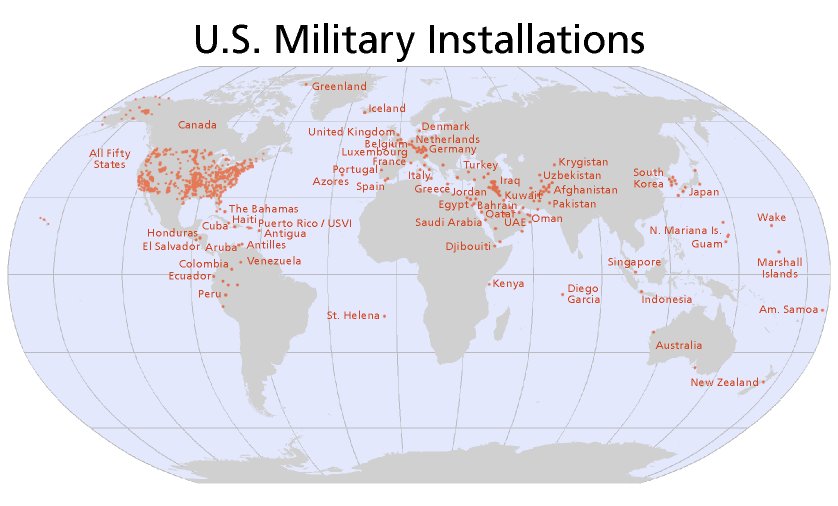
Now let’s take a look at where the US has troops deployed in that same globe…..

Now I realize that a case can be made that this is all about national security….but the Brits had troops stationed in their sphere of control back 100 years or so….and that was billed as national security.

At what point does this look like control more than national security?

Smells like empire to me.

But if you would like more on this situation then please read LobeLog below……and then answer the question.

I’m here to talk about the end of the American empire. But before I do I want to note that one of our most charming characteristics as Americans is our amnesia. I mean, we a…

Source: The End of the American Empire « LobeLog

Is we is or is we ain’t?

Do Not Use The Word “Imperialism”

Inkwell Institute

Subject:  War On Terror

For decades there have been many that have accused the US of being imperialistic, especially in their foreign policy….those accusations were the loudest during the Cold War and most recently by the Islamist states of the Middle East….but could there be any reality to those accusations?

According to some the US Congress is doing its level best to install a policy of imperialistic adventurism and they are trying to cloud this with vague references to the War on Terror…..CommonDreams.org has weighed in on this happening….original article was from the Boston Globe……

The House of Representatives is debating a new definition of America’s military mission in the world, replacing the mandate adopted immediately after 9/11. Instead of merely authorizing the president to make war against those who “committed or aided” the 2001 attacks, the proposed National Defense Authorization Act expands the notion of America’s enemy to include forces “associated” with named antagonists like Al Qaeda and the Taliban.According to its critics (including numerous House Democrats who asked last week that such language be dropped), this seemingly innocuous expansion would, in effect, license an open-ended bleeding of the American battle away from Iraq and Afghanistan to any location in which such vaguely defined associates operate. The two present wars could become three, four, or five, and could shift from the Middle East to Africa, South Asia, or anywhere that a photo, say, of Osama bin Laden hung in the barracks.

For a time in the Bush era, officials and public intellectuals promoted the idea of American empire, declaring it the duty of the United States to maintain planet-wide dominance through military force for the sake of political order and economic well-being — not only of Americans but of the world. This virtuous purpose would make America, in a phrase of the historian Niall Ferguson, “an empire by invitation.” The arrival of terrorism as a mass threat made this hegemonic mission seem inevitable. At some point, the word “empire” fell out of fashion, even on the right. Yet the structures and ideology — and bases — of world-wide dominion reproduced themselves, and soon enough the central assumption of empires embedded itself in American consciousness — the idea that the global rules of order apply to every nation except the one that enforces them.

According to the popular definition……imperialism is the policy of extending a nation’s authority by territorial acquisition or by the establishment of economic and political hegemony over other nations.  If you do not appreciate that definition how about a simple one for adventurism?   Involvement in risky enterprises without regard to proper procedures and possible consequences, especially the reckless intervention by a nation in the affairs of another nation or region……now does any of that sound a bit familiar?

But hey!  If we must invade and flex our military muscle….I think that Jane Stillwater has the perfect solution in BuzzFlash……

Of course plundering Libya does have its good points, I’ll be the first to admit.  By sacking and pillaging its oil-producing cities for their loot, there is much swag to be had — especially if you are working for BP.  However, dollar for dollar, the Cayman Islands have much more loot to offer than almost anywhere else in the world — and I’m not just talking about some eye-popping booty here either.  Unlike Libya, the Cayman Islands are also offering a really first-class place to invade.

Just imagine all those billions and trillions of dollars stored in the bank vaults at Georgetown, just lying there waiting to be had.  And them thar hearty treasures are easy pickings too — because the Caymans, unlike Libya, doesn’t even have an army to defend itself.  No major guided missile systems, no nuclear weapons, not even very many tanks.  Plus the hotels in the Caymans are much nicer than the ones in Libya, giving Anderson Cooper much more comfortable digs to report from than in the Middle East.

I like IT!  Just think of all the billions that we have lost over the years…..Hawks want to use our military superiority…here is the perfect way to do so and pay down the deficit…win-win!

Cry For Haiti

We all have seen the disastrous in Haiti after the massive earthquake…all the death, destruction, misery and hopelessness….we have all watched the world respond generously to the situation…but now I am seeing a pattern that may just not be so….but it is all too familiar.

Writing recently for wsws.org, Bill Van Auken:

From the dawn of the 20th century, Haiti fell under the domination of Washington and the US banks, whose interests were defended by sending Marines to carry out an occupation that continued for nearly 20 years, maintained through the bloody suppression of Haitian resistance.

The Marines left only after carrying out the “Haitianization”—as the New York Times referred to it at the time—of the war against the Haitian people by building an army dedicated to internal repression.

Subsequently, Washington backed the 30-year dictatorship of the Duvaliers, which began with the coming to power of Papa Doc in 1957. While tens of thousands of Haitians died at the hands of the military and the dreaded Tontons Macoute, US imperialism saw the murderous dictatorship as a bulwark against communism and revolution in the Caribbean.

Since the mass upheavals that brought down the Duvaliers in 1986, successive US governments, Democratic and Republican alike, have sought to reconstruct a reliable client state capable of defending the markets and investments of US firms attracted by starvation wages, as well as the property and wealth of the Haitian ruling elite. This entails preventing any challenge to a socio-economic order that keeps 80 percent of the population in dire poverty.

Haiti’s original constitution was written by the commander of US troops that were occupying the island nation some 100 years ago…..

I believe it was Woodrow Wilson that sent the first troops to Haiti in 1913….and the US has been involved in Haiti’s internal affairs ever since…I am hoping that this is not a usual move to try and get a foothold in Haiti once again…to make Haiti into this “little” America in the Caribbean…….but it just seems all too familiar……