Veterans Day–2025

Today is the day we set aside to honor our veterans that honored this country in service.

I also like to bring forth a few memories and such that I seldom talk about with anyone.

I served in Vietnam from 1967-1970 and today I am 79 years old……and I see fellow vets dying off at alarming rates and soon my war and the veterans will be just a fleeting memory that people roll out every November.

For years when people knew that I served in Vietnam they always put forth their opinions on how the war was fought and how we could have won that conflict.

Sadly there will always be these ‘experts’ on war and how it is fought.  My response has always been the same….’if you were not there then your opinions are nothing more than fanciful bullshit’.

Vietnam War ended about 50 years ago and we that were there are still trying to come to terms with it….

April 30th marks the 50th anniversary of the Vietnam War’s end when Vietnamese tanks rolled into Saigon, soon to be renamed Ho Chi Minh City. The war was a terrible experience for the United States, but even more so for the people of Vietnam and much of the rest of Southeast Asia. Estimates are that up to 3 million Vietnamese perished, as well many many thousands of Cambodians and Laotians. Fifty-eight thousand American died, and a trillion American tax dollars were wasted.

Many of us who were there are still trying to understand and come to grips with it. Based on years of study, here is what I think people still get wrong about the war. What I write will be controversial, but it is based on what I saw and learned. If I seem angry, it is because I still am.

In nearly all wars, the other side is demonized and made into evil caricatures of human beings; doing so makes it easier to kill them. From the U.S. perspective, the Vietnam War was no exception. Even the Vietnamese who were supposedly on our side were commonly referred to as gooks, zips (Zero Intelligence Personnel), slants, slopes and more, often to their faces. In my experience, the U.S. military chain of command made no effort to correct this. Given the pervasive racism among American troops, it should come as no surprise that violence against Vietnamese civilians was common. It is hard to understand how anyone thought the Vietnamese people would rally to the U.S. side while being badly treated.

https://www.commondreams.org/opinion/wrong-about-vietnam-war

I still feel that anger…..my country turned it’s back on me and my fellow vets and then 10 years later wanted to welcome us home…..it was too damn late.

The BBC had a very good breakdown of the war and why it was unwinnable from the start….

Another major reason why the USA could not win the war was the lack of support at home from the American public. The huge protest movement divided the country. A major pro–war movement also erupted. Many veterans of the war called the anti–war protesters traitors and communists.

Opposition to the war came from a number of sources and for a number of reasons

Media coverage

This was the first televised war. It was vividly reported by journalists who went to Vietnam in search of stories. Images of innocent civilians being killed, maimed and tortured were displayed on the TV and in newspapers – many Americans were horrified and turned against the war.

Opposition to support for the South Vietnamese Government

The South Vietnamese Government, which the Americans were committed to defending was revealed as corrupt and anti–democratic.

Many Americans questioned how the American Government could justify standing up for this oppressive regime. The USA was meant to fight to protect freedom and democracy.

It became clear that the Vietnamese peasants did not welcome American troops. Many Americans questioned why their country was involved if the local population did not want them there.

Opposition to the ‘Draft’

The ‘Draft’ was the conscription of American men into the US army and lasted from 1954-1975. As sons, brothers and fathers went to war, people began to question whether it was worth it. Draft Law hit African Americans hardest.

Many middle-class Americans opposed the war because, by 1967, the death rate had increased to 160 per week.

Opposition from Civil Rights Movement

There was opposition to the war from civil rights activists, who were fighting for more rights for African-Americans in the USA. Many African-Americans were drafted and because they were new recruits, they were often given the worst postings and assignments. Muhammad Ali had his boxing title revoked for refusing to fight in the war.

Opposition from youth

The main opposition came from students. In the 1960s, protest movements began in California but spread to all the major cities and universities across the USA by 1968.

On 4 May 1970, four peaceful student demonstrators at Kent State University in Ohio were murdered. They were shot by Ohio National Guardsmen during a noon-time campus anti-war rally – this became known at the Kent State Massacre.

Pacifists

Many believed that war was morally wrong. There were mass protests across the USA, including in Washington in December 1969.

Singers wrote anti-war songs and songs that criticised the Vietnam War itself. Bob Dylan wrote ‘Masters of War’ and John Lennon wrote ‘Give Peace A Chance’.

Political opposition

The American Government spent vast amounts of money on the war that could have been spent on domestic problems. Some politicians who had supported the war to begin with, such as Robert McNamara, began to turn against American involvement.

The end of the war in Vietnam

The resignation of President Nixon also weakened US enthusiasm for involvement in Vietnam.

In 1975, the North Vietnamese launched a major offensive and over-ran a series of South Vietnamese strongholds. In May 1975 communist forces took Saigon. In 1976 the two halves of Vietnam were united in a single Socialist Republic.

The Vietnam War was the greatest struggle of the Cold War era and the only major military defeat in United States history.

Please go out and do something nice for a veteran….keeping in mind the sacrifices they made to defend their country and their way of life.

TO ALL MY FELLOW VETERANS….THANK YOU!

This will be my only post today.

Enjoy your day and remember.

I Read, I Write, You Know

“lego ergo scribo

Veteran’s Day–2024

Today the country celebrates our veterans….all those that proudly served the country that we love.

My time was the Vietnam War, I was there for 2 and half years, this conflict is losing its importance and will soon be a war similar to Korea…..people will have heard about it but means little to them.

For me it was a horrible experience that I felt was unnecessary……but was it as bad as it has been painted in film and words?

Over the course of American history, it’s somewhat difficult to find a conflict that’s more infamous and controversial than the Vietnam War. Amidst the messed up events of the Cold War, the U.S. sent increasing numbers of troops to aid South Vietnam in its fight against Communist North Vietnam; by 1954, war had officially broken out, and fighting would rage on for nearly two decades.

The longer the conflict continued, the more the American public actively detested the war. Horrific images from the front marred their screens, high casualty counts eroded support, and the seemingly endless fighting led citizens on the home front to take action against the government. Protests broke out across the nation in response to the drawn-out, unpopular war effort, and in some cases, violent responses by the police and armed forces against protestors only turned popular opinion more sour. By 1973, the U.S. did officially pull out of the war, with the conflict between North and South Vietnam ending two years later.

Nevertheless, the Vietnam War has maintained its infamous reputation over time, and you’re far more likely to hear about its negative aspects than any positive ones. Even so, despite its already dismal reputation, the Vietnam War was actually even worse than you might currently believe, and for a number of different reasons than you might be aware of. Here are some of the darkest facts and effects stemming from it.

Read More: https://www.grunge.com/1664110/why-vietnam-war-worse-than-you-thought/

Please take a few moments out of your busy schedule to remember the veterans that served our great country…..I focus on Vietnam Vets for they were not treated very well when we returned.

I shall spend most of the day sticking to a routine that I have been doing for 30 years.

Back to the usual grind on Tuesday.

Have a good and safe Veterans Day…..

I Read, I Write, You Know

“lego ergo scribo”

National Vietnam War Veterans Day

Today is a day of remembrance, 29 March, of those that fought and died in the hell hole call Southeast Asia.

I bring this up because I was one of those people that spent my youth ass deep in mud and blood…..so my way of celebrating, for lack of a better word, is to share a few things with my readers.

When there is a conversation about this war there is always those that say the US could have won that war if we had wanted to or the ever popular if the president had listened to his generals.

Is this true?

This article tries to disspell some of the manure around such comments….

Historian Mark Moyar revisits the Vietnam War, challenging the consensus that the U.S. couldn’t have won. He contends South Vietnam was a viable state by 1972, capable of repelling North Vietnamese offensives with U.S. aid, and that the war wasn’t as unpopular in the U.S. as believed. However, Moyar overlooks South Vietnam’s reliance on U.S. support, North Vietnam’s advantages, and the U.S.’s inability to fully disrupt the North’s support for the Viet Cong. He underestimates domestic opposition to the war and the improbability of sustaining long-term U.S. involvement. Ultimately, the U.S. withdrawal reflected a strategic decision that the war’s costs outweighed its benefits, with no lasting impact on the global balance of power. The current cooperative relationship between Vietnam and the U.S. suggests the strategic loss was minimal.

Mark Moyar, a scholar of U.S. foreign and military policy, years back had the opportunity to update an older argument on the viability of the Vietnam War. Moyar argues that the historical consensus on the war is wrong on several points, and that in fact the United States could have won the war and preserved the Saigon government at acceptable cost. While Moyar’s argument is worth consideration, he still fails to make his case against the long-standing consensus on the war.

Please read on….

https://nationalinterest.org/blog/reboot/vietnam-war-was-there-anyway-us-military-could-have-won-209574

A nice gesture but I remember how we were treated when we returned to our homeland….

We Viet vets are getting older and starting to die off….soon we will be like those Korean War vets….we will be forgotten and no one will care.

So in the vane of that thought I offer up a comparison on the two forgotten wars….

The Vietnam War and the Korean War stand as two pivotal events, each leaving indelible marks on the world stage. Yet, the curious reality persists: the Vietnam War is remembered vividly, while the Korean War often fades into collective memory. This piece explores the disparities between these conflicts and uncovers the factors influencing the Korean War’s comparative lack of visibility.

https://sofrep.com/news/forgotten-battles-a-comparative-analysis-of-the-vietnam-and-korean-wars/

I disagree that Vietnam is remembered vividly….by those that were there then yes but those that were not or too young it is nothing but a show on the history channel.

If you have a moment in your busy lives please take the time to remember those that did not return.

Be Smart!

Learn Stuff!

I Read, I Write, You Know

“lego ergo scribo”

End Of An Era

The news has come out that effects me and anyone who participated in the antiwar movement from the 70s.

The person that released the secret info to the public through the Pentagon Papers has very little time left in this world.

The “Pentagon Papers”?

This is for those too young to give a shit about this historic incident.

The Pentagon Papers, officially titled Report of the Office of the Secretary of Defense Vietnam Task Force, is a United States Department of Defense history of the United States’ political and military involvement in Vietnam from 1945 to 1967. Released by Daniel Ellsberg, who had worked on the study, they were first brought to the attention of the public on the front page of The New York Times in 1971.  A 1996 article in The New York Times said that the Pentagon Papers had demonstrated, among other things, that the Johnson Administration had “systematically lied, not only to the public but also to Congress.”  (Some things never change…think Ukraine you dullards)

The Pentagon Papers revealed that the U.S. had secretly enlarged the scope of its actions in the Vietnam War with coastal raids on North Vietnam and Marine Corps attacks—none of which were reported in the mainstream media. For his disclosure of the Pentagon Papers, Ellsberg was initially charged with conspiracy, espionage, and theft of government property; charges were later dismissed, after prosecutors investigating the Watergate scandal discovered that the staff members in the Nixon White House had ordered the so-called White House Plumbers to engage in unlawful efforts to discredit Ellsberg.

(wikipedia)

Daniel Ellsberg is dying.

Daniel Ellsberg, who copied and leaked documents that revealed secret details of US strategy in the Vietnam War and became known as the Pentagon Papers, said he has terminal cancer and months to live. Ellsberg posted on his Facebook page Thursday that doctors diagnosed the 91-year-old with inoperable pancreatic cancer on Feb. 17 following medical scans. Doctors say he has three to six months to live, he said. Ellsberg said he has opted not to undergo chemotherapy and plans to accept hospice care when needed, the AP reports.

The documents in the Pentagon Papers looked in excruciating detail at the decisions and strategies of the Vietnam War. They told how US involvement was built up steadily by political leaders and top military brass who were overconfident about US prospects and deceptive about the accomplishments against the North Vietnamese. Ellsberg, a former consultant to the Defense Department, provided the Pentagon Papers to Neil Sheehan, a reporter who broke the story for the New York Times in June 1971. Sheehan died in 2021. Sheehan smuggled the documents out of the Massachusetts apartment where Ellsberg had stashed them, illicitly copied thousands of pages, and took them to the Times.

President Richard Nixon’s administration got a court injunction arguing national security was at stake and publication was stopped. In June 1971, the Supreme Court ruled in favor of allowing publication, and the Times and the Washington Post resumed printing stories. The Nixon administration tried to discredit Ellsberg, an effort that included Nixon aides orchestrating a break-in at the office of Ellsberg’s psychiatrist. Ellsberg was charged with theft, conspiracy, and violations of the Espionage Act, but his case ended in a mistrial when evidence surfaced about government-ordered wiretappings and break-ins. “When I copied the Pentagon Papers in 1969, I had every reason to think I would be spending the rest of my life behind bars. It was a fate I would gladly have accepted if it meant hastening the end of the Vietnam War,” Ellsberg wrote.

This is a letter from Daniel Ellsberg to his supporters….

Dear friends and supporters,

I have difficult news to impart. On February 17, without much warning, I was diagnosed with inoperable pancreatic cancer on the basis of a CT scan and an MRI. (As is usual with pancreatic cancer – which has no early symptoms – it was found while looking for something else, relatively minor). I’m sorry to report to you that my doctors have given me three to six months to live. Of course, they emphasize that everyone’s case is individual; it might be more, or less.

I have chosen not to do chemotherapy (which offers no promise) and I have assurance of great hospice care when needed. Please know: right now, I am not in any physical pain, and in fact, after my hip replacement surgery in late 2021, I feel better physically than I have in years! Moreover, my cardiologist has given me license to abandon my salt-free diet of the last six years. This has improved my quality of life dramatically: the pleasure of eating my former favorite foods! And my energy level is high. Since my diagnosis, I’ve done several interviews and webinars on Ukraine, nuclear weapons, and first amendment issues, and I have two more scheduled this week.

As I just told my son Robert: he’s long known (as my editor) that I work better under a deadline. It turns out that I live better under a deadline!

Living on a Deadline in the Nuclear Age. Some Personal News From Daniel Ellsberg

This man meant a lot to us in the movement….his guts and his drive has been an inspiration for all us that are concerned about the state of our war machine.

His voice will be missed….there are so few voices left in the antiwar movement…..and these days we need all we can get.

I Read, I Write, You Know

“lego ergo scribo”

Vietnam–The Mistakes

Old Professor’s History Class.

I study conflict, war if you will, and have found a couple of events around the war in Vietnam that can be labelled as arrogant mistakes….first by France and then by the US.

I realize there have been volumes written about this conflict….but few by people that actually fought that war.

As a veteran of this war I have studied and made my thoughts known….but there were more mistakes than just those of the US….France for instance was just as arrogant as the US and it cost them the territory and the war….a war that the US had to pick up and carry on (more on that further into this post)……

First thing to do is to throw all the Hollywood adaptations of this war down the toilet (TP not needed)……most of that stuff was total bullshit…….

France’s biggest screw up was arrogantly thinking they had a force, the Viet Minh, that was backward and incapable of carry on a proper war…..that was true and Giap decided that a guerilla war would accomplish the desires of throwing the French from Vietnamese soil.

The final nail in the coffin of the French in Vietnam was the battle of Dien Bien Phu……

It is 1954 in Southeast Asia….the French have been fighting for years against the Viet Minh under Ho and Giap and the French decided to make one final push to destroy opposition and be done with this war.  Sadly it did not work out as brilliantly as the French had promised……in fact a band of guerillas with no technology, aircraft, etc. handed the French their asses…..

The most consequential military engagement in Southeast Asia in the 20th century is the 1954 Battle of Dien Bien Phu. It was fought ostensibly between the French and the communist-led Viet Minh at Dien Bien Phu, an obscure valley bordering China, in the remote northwestern part of what was then French Indochina. The battle ended with a humiliating defeat for the French, which brought down the French government, ended French colonial rule in Asia, ushered in America’s epic military involvement in the region for decades to come, and fundamentally changed the global geostrategic landscape.

How the French lost this pivotal battle is just as telling as how significant the French defeat became.

https://www.hoover.org/research/lessons-dien-bien-phu

This conflict is seldom taught classes these days….and I think it should be mandatory…..this conflict illustrates just how very brilliant of a guerilla war can be…..and could have prevented mistakes.

Not all the mistakes we by the French in the Southeast Asian wars…..the US was just as arrogant as the French.

That brings me to the Tet Offensive…..

I was fortunate enough to live through those days of constant fighting….

I was a member of a LRRP team (long range recon) and for days we were watching a NVA troop movement we identified the unit as the 174th NVA Regitment…..we made our way back to base and reported what we had found and were basically called liars for they had info that they were camped 100 km northwest of the position we reported….in other words they believed signal intel over human intel and it bit them in the ass for the 174th was one of the units that did a lot of damage.

Finally someone has written about the lack of any good human intel in Vietnam……

The intelligence failings fall into three broad categories. In Vietnam, the US military possessed a lack of foresight, neglected fundamental intelligence-gathering principles, and suffered from an absence of strategy and direction.

On a fundamental level, US military intelligence was unable to gauge the level of communist infiltration in the South of the country. This meant the US forces had almost no idea of the size of the enemy’s forces

https://parlia.com/a/Pb7sF3gPgNp5NmfJLP7FzZj/why-did-the-us-lose-the-vietnam-war/us-strategic-failures/intelligence-failures

It was a lie then and it is a lie now!

The officials were told what was coming and everyone decide to believe a pile of mumbo jumbo from the electronics instead of those that had witnessed the movements.

For those interested this is the declassified reports……

https://www.intelligence.gov/tet-declassified/tet-declassified-documents

Further Reading:

https://www.thehistorypress.co.uk/articles/the-vietnam-war-tet-offensive/

https://www.britannica.com/topic/Tet-Offensive

I Read, I Write, You Know

“lego ergo scribo”

We Kicked The Vietnam Syndrome!

Good news for us…Sally went East and we got a little rain and some wind……the old news is that Florida is getting hammered……

Time for some history…..

That was the proclamation of Pres. George H.W. Bush at the end of the 1991 Gulf War.

I guess the best place to start is to explain the term “Vietnam Syndrome”…..

It is the belief, born of brutal experience during the Vietnam War, that never again will the United States gradually tiptoe into questionable wars without a clearcut objective, overwhelming military force, an endgame strategy and, most important, the support of Congress and the American people.

It’s Called the Vietnam Syndrome, and It’s Back

When you think of the word, ‘syndrome,’ you might think of a medical disease – something which is perhaps not overt but still affects an individual’s functions and decisions. The same was true for the political and societal phenomenon known as the Vietnam Syndrome, which refers to America’s wariness to engage in any foreign conflicts after the Vietnam War. In this lesson, we will explore the roots of Vietnam Syndrome and how it manifested itself in our society.

But what causes this “affliction”?

Vietnam Syndrome was caused, in part, by the haphazard way the United States intervened in the Vietnam conflict and the debacle it became. The United States fought a brief but large war in Vietnam, seemingly by accident. The United States first sent advisors to South Vietnam in the 1950s to train troops. The goal was to aid the failing democratic state and stop the spread of communism in Asia. Throughout the late 1950s and early 1960s, more and more military personnel were sent to support that mission.

By 1968, there were more than half a million American troops in Vietnam providing the backbone of South Vietnam’s resistance to North Vietnam, which sought to unify the country under communist rule. Ill-equipped and ill-trained for a guerrilla war in the jungles of Vietnam, U.S. forces took heavy casualties. By the time the last American troops were withdrawn in 1973, more than 58,000 U.S. servicemen and women were either dead, missing, or presumed dead. To make matters worse, these deaths ultimately occurred in vain; South Vietnam fell to the communists once and for all two years later.

https://study.com/academy/lesson/vietnam-syndrome-definition-causes-impact.html

I bring this all up because we are approaching the 30 years anniversary of this conflict…..and the question should be….what did we learn from our war in the Gulf?

According to documents of the time…….

According to National Security Directive 54, dated Jan. 15, 1991, there were four major war aims: complete Iraqi withdrawal from Kuwait, restore Kuwait’s government, protect American lives (in particular, free hostages), and “promote the security and the stability of the Persian Gulf.”

On the last aim we failed miserably.

So was the war a rip roaring success that we have been led to believe?

Was the Gulf War (1990 to 1991) a success for the United States? To many, the answer is unequivocally “yes.” After all, the United States rallied the international community to punish aggression and liberate a small country (Kuwait) that had been invaded by its larger, authoritarian neighbor (Iraq). The country marshaled its formidable instruments of diplomatic, informational, military, and economic power to garner international support and achieved its objectives quickly at a relatively limited cost; adeptly executed joint and multinational military operations; and displayed astonishing military capabilities heralded as the beginning of a “revolution in military affairs.” These elements of the U.S. campaign should be celebrated and, where possible, emulated in the future.

But the United States should be careful not to mythologize its performance in the Gulf War. For example, war termination was handled haphazardly in a manner that hurt policy goals for regional stability. Following the war, great-power and non-state competitors sought to identify and exploit U.S. vulnerabilities with asymmetric responses while excessive military deference from allies often placed a greater burden on the United States. Lastly, U.S. military prowess in the war led to hubris, and reinforced a neglect for diplomacy, irregular warfare, stability operations, and governance. The country should continue to study the record of the Gulf War to identify and attend to demonstrated deficiencies, and to analyze subsequent responses of adversaries and allies.

The Gulf War 30 Years Later: Successes, Failures, and Blind Spots

We did nothing to secure the Middle East….in the long rub we made matters worse.

Learn Stuff!

I Read, I Write, You Know

“lego ergo scribo”

“Get Over It!”

It is the “real” Memorial Day and as a Vietnam veteran I have often wondered why all the films made about that war feature mostly white guys….Blacks came home to worse things than us whites….and no one has ever cared…..

Spike Lee will change that…..finally the story of black Vietnam veterans will be told.

When Dedan Kimathi Ji Jaga returned from combat in Vietnam, he painted his walls black, covered his windows and sat in darkness all day. His injuries and post-traumatic stress were severe, but as with many African American soldiers in 1968, the US government gave him little support.

“They summarily released me back to the streets with no aid,” said the 72-year-old California resident.

Black veterans across America are hoping this painful and enduring legacy will get the attention it deserves in Spike Lee’s new film, Da 5 Bloods, which chronicles the journey of four African American vets who return to Vietnam in search of their fallen squad leader and buried gold.

“The plight of African American service members who served in Vietnam, where they are now, why they are the way they are, this should be brought to light,” said Richard D Kingsberry, a veteran in Charlotte, North Carolina, who began his service in 1972 in the navy. “A lot of African American service members never got cared for properly after they returned, and that is a life-altering impact.”

https://www.theguardian.com/film/2020/may/22/spike-lee-vietnam-da-5-bloods-black-veterans

After so many years their stories can be told…..a bit late but maybe it will help people understand….

Here is a story that will NEVER be told…..

Image

I Read, I Write, You Know

“lego ergo scribo”

Hamburger Hill

Closing Thought–12May20

It’s official designation is Hill 937…..or Ap Bia Mountain…….in the A Shau Valley……

51 years ago this week….the US forces faced the forces of the Army of North Vietnam…..a loss of 400 American soldiers and 600 for the NVA…..the battle was fought over 10 days in 1969.

This battle was a failure in more ways than not…..and helped turn the temperament of the nation against the war…..there was more to this battle than the entertainment of the movies….

Information on the Battle of Hamburger Hill during The Vietnam War, also known as Hill 937. The battle, which was fought on May 10-20, 1969 was a direct assault against a heavily defended and strategically insignificant hill, resulted in over 400 U.S. casualties and caused an outrage back home.

‘Don’t mean nothin’. That was the refrain of the powerful 1987 movie about the battle for Hamburger Hill, more correctly called Ap Bia Mountain or Hill 937. Many veterans of that May 1969 fight would no doubt agree, since the hill was abandoned to the enemy soon after it was taken. But the truth is that it was one of the most significant battles of the war, for it spelled the end of major American ground combat operations in Vietnam.

The Hamburger Hill battle had run afoul of a fundamental war-fighting equation. Master philosopher of war Karl von Clausewitz emphasized almost a century and a half earlier that because war is controlled by its political object, the value of this object must determine the sacrifices to be made for it both in magnitude and also in duration. He went on to say, Once the expenditure of effort exceeds the value of the political object, the object must be renounced. And that’s exactly what happened. The expenditure of effort at Hamburger Hill exceeded the value the American people attached to the war in Vietnam. The public had turned against the war a year and a half earlier, and it was their intense reaction to the cost of that battle in American lives, inflamed by sensationalist media reporting, that forced the Nixon administration to order the end of major tactical ground operations.

Battle Of Hamburger Hill During The Vietnam War

“When will we ever learn?”

I Read, I Write, You Know

“lego ergo scribo”

Kent State–50 Years On

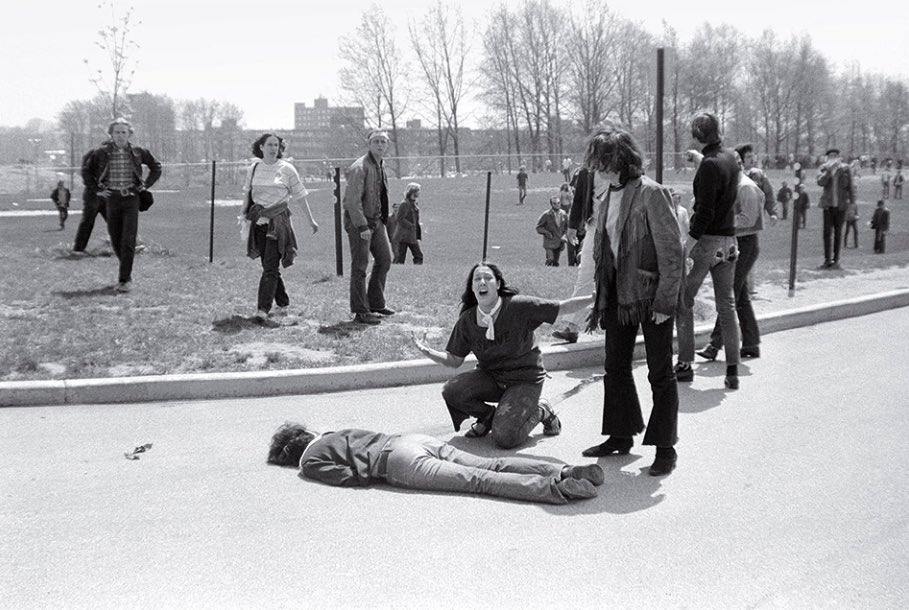
Before the days when cops have a free hand at killing American citizens….there were antiwar protests all over the nation……one particularly deadly encounter was Kent State….

Do you remember this iconic photo from the massacre?

Image

On this day in 1970 Ohioan National Guard open fire on protesting students……with disastrous results….death and maiming……

On May 4, 1970, in Kent, Ohio, 28 National Guardsmen fire their weapons at a group of anti-war demonstrators on the Kent State University campus, killing four students, wounding eight, and permanently paralyzing another. The tragedy was a watershed moment for a nation divided by the conflict in Vietnam, and further galvanized the anti-war movement

Two days earlier, on May 2, National Guard troops were called to Kent to suppress students rioting in protest of the Vietnam War and the U.S. invasion of Cambodia. The next day, scattered protests were dispersed by tear gas, and on May 4 class resumed at Kent State University. By noon that day, despite a ban on rallies, some 2,000 people had assembled on the campus. National Guard troops arrived and ordered the crowd to disperse, fired tear gas, and advanced against the students with bayonets fixed on their rifles. Some of the protesters, refusing to yield, responded by throwing rocks and verbally taunting the troops.

https://www.history.com/this-day-in-history/national-guard-kills-four-at-kent-state

What did those deaths accomplish?

https://www.military.com/daily-news/2020/05/03/day-all-hell-broke-loose-local-lives-lost-forever-changed-kent-state-shooting-50-years-ago.html

As usual nothing happened…other than the deaths of some students….of which some were not part of the protest…..and yet they are dead…..

Phillip Lafayette Gibbs met Dale Adams when they were in high school, in Ripley, Mississippi, a town best known as the home of William Faulkner’s great-grandfather, who ran a slave plantation, fought in the Mexican-American War, raised troops that joined the Confederate Army, wrote a best-selling mystery about a murder on a steamboat, shot a man to death and got away with it, and was elected to the Mississippi legislature. He was killed before he could take his seat, but that seat would have been two hundred miles away in the state capitol, in Jackson, a city named for Andrew Jackson, who ran a slave plantation, fought in the War of 1812, was famous for killing Indians, shot a man to death and got away with it, and was elected President of the United States. Phillip Gibbs’s father and Dale Adams’s father had both been sharecroppers:  they came from families who had been held as slaves by families like the Jacksons and the Faulkners, by force of arms.

https://www.newyorker.com/magazine/2020/05/04/kent-state-and-the-war-that-never-ended

For those that did not read the links….these are the names and wounded at Kent State on 04 May 1970…..

Killed (and approximate distance from the National Guard):

  • Jeffrey Glenn Miller; age 20; 265 ft (81 m) shot through the mouth; killed instantly
  • Allison B. Krause; age 19; 343 ft (105 m) fatal left chest wound; died later that day
  • William Knox Schroeder; age 19; 382 ft (116 m) fatal chest wound; died almost an hour later in a local hospital while undergoing surgery
  • Sandra Lee Scheuer; age 20; 390 ft (120 m) fatal neck wound; died a few minutes later from loss of blood

Wounded (and approximate distance from the National Guard):

  • Joseph Lewis, Jr.; 71 ft (22 m); hit twice in the right abdomen and left lower leg
  • John R. Cleary; 110 ft (34 m); upper left chest wound
  • Thomas Mark Grace; 225 ft (69 m); struck in left ankle
  • Alan Michael Canfora; 225 ft (69 m); hit in his right wrist
  • Dean R. Kahler; 300 ft (91 m); back wound fracturing the vertebrae, permanently paralyzed from the chest down
  • Douglas Alan Wrentmore; 329 ft (100 m); hit in his right knee
  • James Dennis Russell; 375 ft (114 m); hit in his right thigh from a bullet and in the right forehead by birdshot, both wounds minor
  • Robert Follis Stamps; 495 ft (151 m); hit in his right buttock
  • Donald Scott MacKenzie; 750 ft (230 m); neck wound

Least we forget……may they R.I.P.

I Read, I Write, You Know

“Lego ergo scribo”

The “Angels Of Dien Bien Phu”

I wrote a piece for women’s history month and the notes got lost on my desk and it did not make it when intended….

Dien Bien Phu was the battle that took France out of Southeast Asia….a little background is probably needed for Vietnam is quickly becoming a war to forget for most Americans…..

In November 1953, the French, weary of jungle warfare, occupied Dien Bien Phu, a small mountain outpost on the Vietnamese border near Laos. Although the Vietnamese rapidly cut off all roads to the fort, the French were confident that they could be supplied by air. The fort was also out in the open, and the French believed that their superior artillery would keep the position safe. In 1954, the Viet Minh army, under General Vo Nguyen Giap, moved against Dien Bien Phu and in March encircled it with 40,000 Communist troops and heavy artillery.

The first Viet Minh assault against the 13,000 entrenched French troops came on March 12, and despite massive air support, the French held only two square miles by late April. On May 7, after 57 days of siege, the French positions collapsed. Although the defeat brought an end to French colonial efforts in Indochina, the United States soon stepped up to fill the vacuum, increasing military aid to South Vietnam and sending the first U.S. military advisers to the country in 1959.

https://www.history.com/this-day-in-history/french-defeated-at-dien-bien-phu

The “angel”…..Her name was Genevieve de Galard…..

Born into a storied family, Geneviève de Galard was shaped by its patriotic spirit and even as a youth felt a need to prove herself worthy of its heritage. Only 14 at the outset of World War II, she faced the horrors and hardships of Nazi occupation in her most formative years. Completing her education after liberation, she eschewed a life of privilege to pursue a path of giving through nursing. Fueled by patriotism and intrigued by the raging colonial conflict in Indochina, she became a flight nurse for the French airforce and made her first tour to Vietnam in April 1953 as the war against the Viet Minh grew more desperate. Based in Hanoi, in January 1954 she began working on evacuation flights from Dien Bien Phu, the isolated outpost that quickly became the focus of the war as some 11,000 French soldiers came under siege. By March 28, de Galard had flown dozens of evacuation missions to and from the outpost and had no reason to fear the flight that day would be her last—and that over the next 56 days, as the only woman at the base, she would become a worldwide icon of hope and compassion.

An Angel in Dien Bien Phu’s Hell

I will be writing more on the debacle of Dien Bien Phu later…..

I apolgize for not posting this when the interest would have been high…..none the less this fascinating women deserves all the accolades she has received.

Learn Stuff!

Class Dismissed!

I Read, I Write, You Know

“lego ergo scribo”